








1. What is COPA?
New York City’s Community Opportunity to Purchase Act (COPA) is a proposed local law in the City Council, officially Intro 902-2024.
According to the Council’s own summary, the bill would:
give certain qualified entities (nonprofits, community land trusts, etc.) a first opportunity to purchase certain residential buildings and a chance to match other offers when those buildings are put up for sale. New York City Council
A recent overview by amNY and other outlets confirms that COPA applies to most buildings with three or more residential units. Owners of such buildings who decide to sell would have to follow special procedures before selling to anyone else. amNewYork+1
2. Which buildings are covered?
In general, COPA covers:
- Private residential buildings with 3+ apartments
- Some mixed-use properties, as long as they meet that residential unit threshold
Legal and advocacy summaries describe this as about “multifamily rental buildings”, not one- and two-family homes that people live in themselves. New York City Council+2Holland & Knight+2
There are technical exceptions (for example, certain court-ordered sales or transfers within a family), but the basic idea is:
if it’s a normal market sale of a 3+ unit building, COPA rules apply.
3. The sale process without COPA (today)
Right now, a typical sale looks like this:
- Owner decides to sell.
- Hires a broker or quietly finds a buyer.
- Negotiates price and terms.
- Signs contract, clears due diligence, closes the deal.
The city isn’t deeply involved unless there are existing subsidies, rent regulations, or violations. Buyers and sellers mostly negotiate directly.
4. How the process would change with COPA
Under COPA, several new steps are added before the owner can close with a private buyer.
Step 1 – Owner must notify the city and nonprofits
When an owner wants to sell a covered building, they must send a notice of intent to sell to:
- NYC’s Department of Housing Preservation and Development (HPD), and
- a city-maintained list of “qualified entities” (mission-driven nonprofits, community land trusts, etc.). New York City Council+1
Step 2 – Nonprofits get the first opportunity to buy
Once the notice is sent:
- Qualified nonprofits have a set period (described in multiple summaries as up to 120 days) to submit an offer to buy the building.
- During this “exclusive” window, the owner is not allowed to accept offers from other buyers. crefc.org+1
Different write-ups use slightly different numbers (60 days to express interest plus up to 120 days to make an offer), but they all agree on the core point:
nonprofits move to the front of the line and get extra time to act.
Step 3 – If a private buyer appears, nonprofits can match
Even after the first window, COPA doesn’t simply step aside.
If the owner later gets a “bona fide” offer from a private buyer:
- The owner must notify HPD and the nonprofits again.
- At that point, a qualified nonprofit gets an additional period (again described as up to 120 days) to match that offer — same price, same main terms. crefc.org+2New York City Council+2
So nonprofits are not getting a discount; they are getting priority in time and a right to match.
Step 4 – Penalties for ignoring COPA
If an owner tries to sell a covered building without following these steps:
- They can face civil penalties up to $30,000, and
- Qualified entities can go to court to enforce their rights (for example, to block or unwind a non-compliant sale). realestatelanduseandenvironmentallaw.com+2Instagram+2
5. Why supporters want COPA
Advocacy groups like NYC Community Land Initiative and New Economy Project frame COPA as a tool to fight displacement and speculative buying. Their own materials say COPA would:
- give community land trusts and “mission-driven nonprofits” a first right to purchase multifamily buildings when landlords sell;
- help “curb speculation and level the playing field” so nonprofits can compete with investors;
- expand the stock of “permanently affordable, community- and tenant-controlled housing.” nyccli.org+2nyccli.org+2
These groups also point to other cities:
- Washington, D.C. – TOPA (Tenant Opportunity to Purchase Act)
A 2023 study found TOPA helped develop or preserve 16,224 affordable units over several decades, giving tenants leverage when buildings are sold. The Coalition - San Francisco – COPA (since 2019)
San Francisco’s COPA gives qualified nonprofits a similar first right of offer and first right of refusal for buildings with 3+ units, specifically to promote and preserve affordable housing. San Francisco Government+2Hanson Bridgett LLP+2
From this point of view, NYC’s COPA is a way to copy policies that have already helped preserve thousands of units elsewhere, rather than inventing something totally new.
6. Why critics are worried
Landlord associations, lender groups, and several law firms that advise owners have raised concerns. Their public memos and alerts focus on three main issues.
6.1. Delays and uncertainty
A briefing from the Commercial Real Estate Finance Council (CREFC) and articles by firms like Holland & Knight warn that Intro 902 could:
- add many months to a normal sale, as owners wait out COPA timelines;
- make it hard to complete time-sensitive deals like 1031 exchanges;
- scare off buyers who don’t want their carefully negotiated offer matched at the last minute by someone else. crefc.org+2Holland & Knight+2
6.2. Lower building values and tax revenue
Because of that extra risk and delay, critics say:
- buyers might only bid if they get a discount to compensate,
- which could push down appraised values of multifamily buildings,
- and ultimately reduce what the city collects in property-related taxes on sales. Holland & Knight+1
6.3. Advantage for politically connected nonprofits
All sides agree that COPA’s “qualified entities” list will be maintained by HPD. That means:
- some nonprofits will be on the list and get first shot at deals,
- others won’t,
- and tenants themselves only get priority when they partner with or work through one of these entities. New York City Council+2nyccli.org+2
Skeptics argue this could:
- concentrate power in a small group of large, well-connected organizations,
- give them a kind of “soft veto” over many building sales,
- and create opportunities for favoritism in who gets certified and which deals move forward.
The New York Post goes much further in its language, calling COPA a step toward a “communist dystopia,” but those are editorial characterizations, not concrete legal claims. New York Post
7. What similar laws have actually done elsewhere
Looking at other cities helps separate fears from reality.
Washington, D.C. (TOPA)
- TOPA has been used to preserve many affordable units (over 16,000 by one major study). The Coalition
- At the same time, D.C. has recently scaled back TOPA for small 2–4 unit buildings, after complaints from small landlords about complexity and delays. The Washington Post+1
So TOPA shows that:
- the model can work as a preservation tool,
- but it can also create enough friction that lawmakers later adjust it for certain property types.
San Francisco (COPA)
- SF’s COPA, in effect since 2019, requires owners of 3+ unit buildings to notify a list of qualified nonprofits and give them first right of offer and refusal. San Francisco Government+2Hanson Bridgett LLP+2
- Nonprofits there have successfully acquired and preserved a number of buildings, but real-estate attorneys note that sales have become more complex and timing-sensitive. Bornstein Law+1
8. What COPA would likely mean for NYC
Putting all this together, an explanation-style summary looks like this:
- What the law does in practice
- Gives city-approved nonprofits and land trusts first dibs on many multifamily buildings.
- Lets them match later offers from private buyers.
- Enforces this with fines and the possibility of blocking non-compliant sales.
- Who benefits directly
- Nonprofits with the capacity and funding to move on buildings.
- Tenant groups that are organized enough to partner with those nonprofits.
- Main trade-offs
- Pros: Likely preservation of some existing buildings as permanently affordable; more leverage for communities in high-pressure markets.
- Cons: Slower, more complicated sales; potential downward pressure on building values; higher transaction costs; more power concentrated in a relatively small circle of qualified organizations.
- Political status
- As of November 2025, advocacy groups say COPA has reached supermajority support in the City Council, meaning it could potentially survive a mayoral veto if that support holds. neweconomynyc.org+1
9. How to read the debate
If you strip away the rhetoric, the core question COPA raises is:
Should the city slow down and reshape the sale of multifamily buildings, so nonprofits have a better chance to buy them — even if that makes transactions more bureaucratic, less flexible, and potentially less attractive to some private buyers?
Supporters think the preservation benefits are worth the extra steps.
Critics think the red tape and market distortions will backfire.
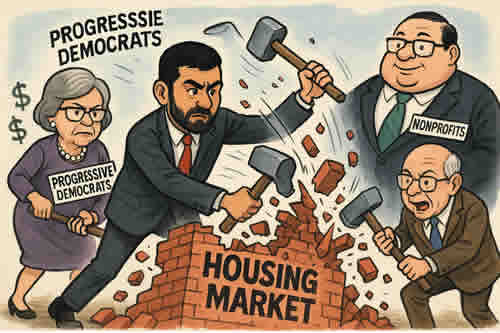
Whatever your own view, understanding the mechanics above makes it easier to see what’s really at stake when people argue that COPA will either “save affordable housing” or “kill the housing market.”
Sources: Midtown Tribune , legistar.council.nyc.gov