
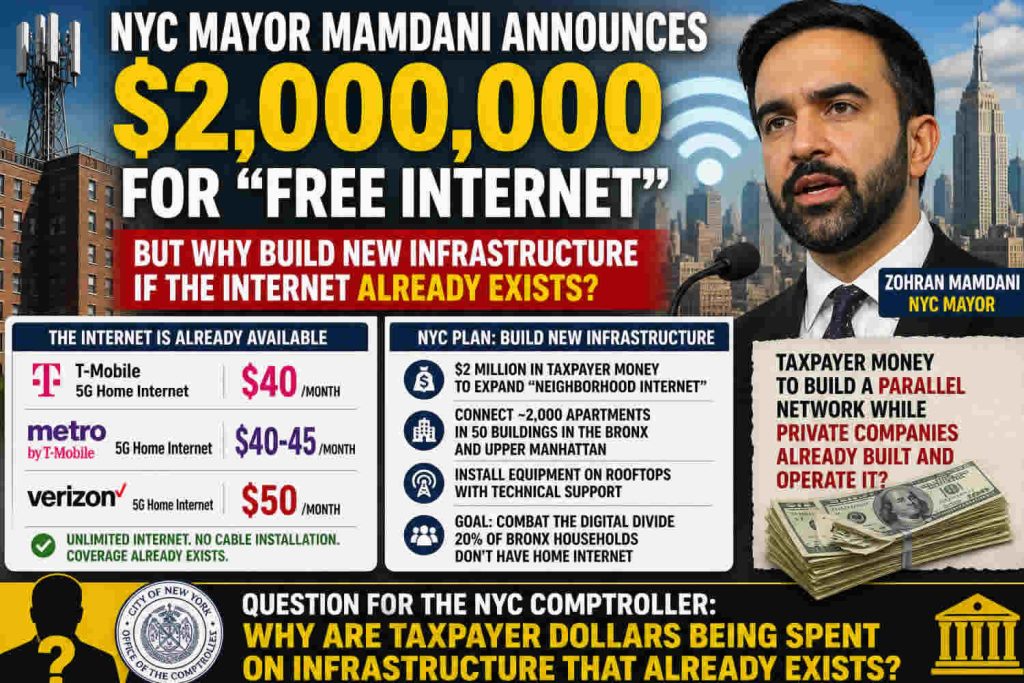
Why is New York City funding a new “free internet” program when private 5G networks already cover the city?
Main Announcement
The administration of Mayor Zohran Mamdani, together with Representative Ritchie Torres, announced an additional $2 million in federal funding to expand the “Neighborhood Internet” program.
According to the official statement, the program will provide free internet access to approximately 2,000 apartments across 50 buildings, building on an existing pilot that already serves 2,200 apartments in 39 buildings.
City officials describe the initiative as a step toward “digital equity” and emphasize that internet access should be treated as a basic necessity and public good.
The Core Question
However, a fundamental question remains:
why is the city investing in new infrastructure when the infrastructure already exists?
Private companies already offer wireless home internet across New York City. For example, 5G Home Internet plans are widely available for around $40–$50 per month, with no contracts, no data caps, and no installation costs.
If the problem is affordability — not availability — then the policy response becomes unclear.
Alternative Approach
Instead of funding a parallel system with rooftop equipment, contractors, and long-term maintenance costs, the city could adopt a simpler and more direct solution:
Provide targeted subsidies or vouchers (e.g., $40/month) to low-income households to use existing private internet services.
This would:
- connect families immediately, without new infrastructure;
- reduce administrative and operational costs;
- avoid duplication of existing networks;
- allow residents to choose their provider.
Conclusion
The issue is not whether low-income families need internet access — they clearly do.
The real question is:
why are taxpayer and federal funds being used to build or support a new system when private infrastructure is already in place and functioning?
Is this about solving a practical problem — or expanding the role of government in providing digital services?
Official Source (NYC.gov — Press Release)
This article is based on the official press release published by the NYC Mayor’s Office:
Mamdani Administration, Rep. Ritchie Torres Announce $2 Million to Expand Free Broadband Internet Access
.
Source type: Press release (summary with official statements and quotes, not a full transcript).
Below is a verified excerpt from the official publication for context:
View key excerpts from NYC.gov
Key excerpts
“This $2 million investment in the Neighborhood Internet program is a major step toward closing the digital gap and expanding access to opportunity,” said Mayor Zohran Mamdani.
The program will expand high-speed internet access to low-income households in the Bronx and Upper Manhattan, reaching thousands of apartments.
Officials emphasized that internet access is essential for jobs, education, healthcare, and daily life in the modern economy.
The expansion is funded through federal Community Project Funding secured by Representative Ritchie Torres.
Infrastructure investments include rooftop network equipment, installation work, and connectivity inside residential units.
Note: This section provides excerpts for verification and context. The full official publication is available at the source link above.
Key Facts
- NYC announced $2 million in federal funding for the Neighborhood Internet program.
- The program is expected to serve about 2,000 additional apartments in 50 buildings.
- The existing pilot covers about 2,200 apartments in 39 affordable housing buildings.
- City officials argue the program addresses digital inequality in the Bronx and Upper Manhattan.
- The policy question: why fund new infrastructure if private 5G home internet already exists?
Q&A
What did the Mamdani administration announce?
The administration announced $2 million in additional federal funding to expand free broadband access through the Neighborhood Internet program.
Who is supposed to benefit?
The program targets residents of affordable housing buildings in the Bronx and Upper Manhattan, especially households without reliable home internet.
What is the main criticism?
The main criticism is that New York City already has private wireless and 5G internet infrastructure, so the city should explain why public funds are being used for a parallel system.
What alternative could be cheaper?
A direct voucher or subsidy for low-income households could allow families to use existing private internet plans instead of funding new equipment and administration.
What question should the NYC Comptroller ask?
The Comptroller should ask whether this spending is necessary, cost-effective, and justified when private internet infrastructure already exists and operates across the city.