
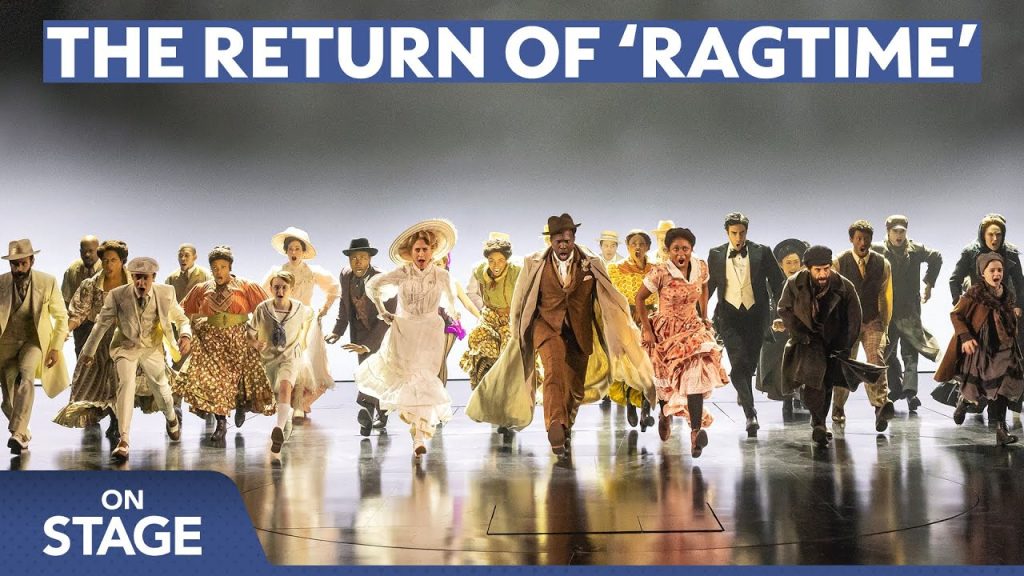
“Ragtime” Returns to Broadway: The Sound of America, Then and Now
One of Broadway’s most powerful American musicals has returned to New York. “Ragtime,” the sweeping musical that first premiered on Broadway in 1998, is back this season in a major revival from Lincoln Center Theater at the Vivian Beaumont Theater.
In a recent NY1 / Spectrum News “On Stage” feature, host Frank DiLella visited the “Ragtime” company to speak with the cast and creative team about bringing this landmark musical back to the stage in 2026.
The timing is important. “Ragtime” is not only a musical about the past. It is a musical about America itself — about immigration, race, family, class, ambition, injustice, and the complicated promise of the American dream.
A Broadway Classic Returns
“Ragtime” is based on the novel by E. L. Doctorow, with music by Stephen Flaherty, lyrics by Lynn Ahrens, and a book by the late Terrence McNally.
The original Broadway production opened in 1998 and became one of the defining musicals of its era. It starred major Broadway figures including Brian Stokes Mitchell, Audra McDonald, Peter Friedman, and the late Marin Mazzie.
Decades later, the story has returned in grand form at Lincoln Center Theater. The new revival places the same central questions in front of a modern audience: Who belongs in America? Who gets to dream? And what happens when different versions of America collide?
Three Families, One American Story
Set at the turn of the 20th century, “Ragtime” follows three major storylines.
One centers on an upper-class white family from New Rochelle, represented by the character known as Mother. Another follows Coalhouse Walker Jr., a Black musician from Harlem. The third follows Tateh, a Jewish immigrant and artist trying to build a new life in the United States.
Together, their stories form a portrait of America in motion — a country shaped by immigration, industrial growth, racial conflict, social change, and the search for dignity.
The new production stars Joshua Henry as Coalhouse Walker Jr., Caissie Levy as Mother, and Tony Award winner Brandon Uranowitz as Tateh.
The Music of Different Americas
One of the strongest elements of “Ragtime” is the way its score gives each world its own sound.
In the NY1 interview, composer Stephen Flaherty explains that the music for Tateh carries elements of the old world and the new. Mother’s world has the sound of American parlors, marches, and early 20th-century popular music. Coalhouse Walker’s world brings the energy and rhythm of Harlem.
As the characters’ lives intersect, the music begins to blend. That is one of the great achievements of “Ragtime”: the score itself becomes a metaphor for America — separate voices becoming something larger, more complex, and more powerful.
Brandon Uranowitz and a Personal Return
For Brandon Uranowitz, this revival is deeply personal. In the interview, he recalls being involved with an early pre-Broadway version of “Ragtime” as a child. Years later, he returns to the show not as a child performer, but as Tateh — a role closely connected to his own family history and identity.
His story gives the revival an added emotional layer. “Ragtime” is a musical about memory, inheritance, and the long road toward finding one’s rightful place. For Uranowitz, returning to the show after nearly three decades makes that theme real.
Joshua Henry and the Legacy of Coalhouse Walker
Joshua Henry steps into the role of Coalhouse Walker Jr., originally played on Broadway by Brian Stokes Mitchell. In the NY1 feature, Henry describes the emotional power of receiving encouragement from Mitchell himself.
That passing of the torch matters. Coalhouse is one of the most demanding and symbolic roles in American musical theater. He represents talent, pride, dignity, love, anger, and the devastating consequences of injustice.
In 2026, Coalhouse’s story remains painfully relevant. It speaks to racial inequality, the limits of respectability, and the question of how long a person can be asked to endure humiliation before demanding justice.
Honoring Marin Mazzie
Caissie Levy plays Mother, a role created in the original Broadway production by Marin Mazzie, who died in 2018 from ovarian cancer.
Levy speaks with deep respect about Mazzie’s legacy. Mother is one of the great transformation roles in musical theater: a woman who begins inside a protected world and slowly awakens to the reality of a larger, more complicated America.
Through Mother, “Ragtime” asks whether comfort can survive moral awakening — and whether privilege can become compassion.
Why “Ragtime” Matters in 2026
The reason “Ragtime” still works is simple: it does not treat American history as something safely buried in the past.
The musical deals with themes that remain central today: immigration, race, economic inequality, identity, family, and belonging. It shows America as a place of opportunity, but also as a place of conflict. It celebrates hope without denying suffering.
That balance is why the revival feels urgent. In a time when Americans continue to debate immigration, national identity, social justice, and the meaning of the American dream, “Ragtime” offers a theatrical mirror.
It does not give easy answers. Instead, it asks the audience to look at the country honestly.
A Musical for Immigrants, Dreamers, and New Yorkers
One of the most moving ideas from the NY1 segment is that “Ragtime” should be seen by people who feel unseen — especially immigrants and people trying to find their place in a dominant culture.
That message is especially powerful in New York City. New York has always been a city of arrival, struggle, reinvention, ambition, and cultural collision. In that sense, “Ragtime” does not just belong on Broadway. It belongs in New York.
The musical reminds audiences that the American dream has never been simple. It has always been built from hope, labor, conflict, music, courage, and loss.
Conclusion
“Ragtime” returns to Broadway not as nostalgia, but as a living American story.
At Lincoln Center Theater, the musical once again asks what kind of country America wants to be — and who gets to be included in that dream. With its powerful score, emotional performances, and deeply relevant themes, “Ragtime” remains one of Broadway’s most important works.
For New York audiences in 2026, this revival is more than a theater event. It is a reminder that America’s story is still being written.