
By BigNY.com News Desk
June 14, 2026 | New York City
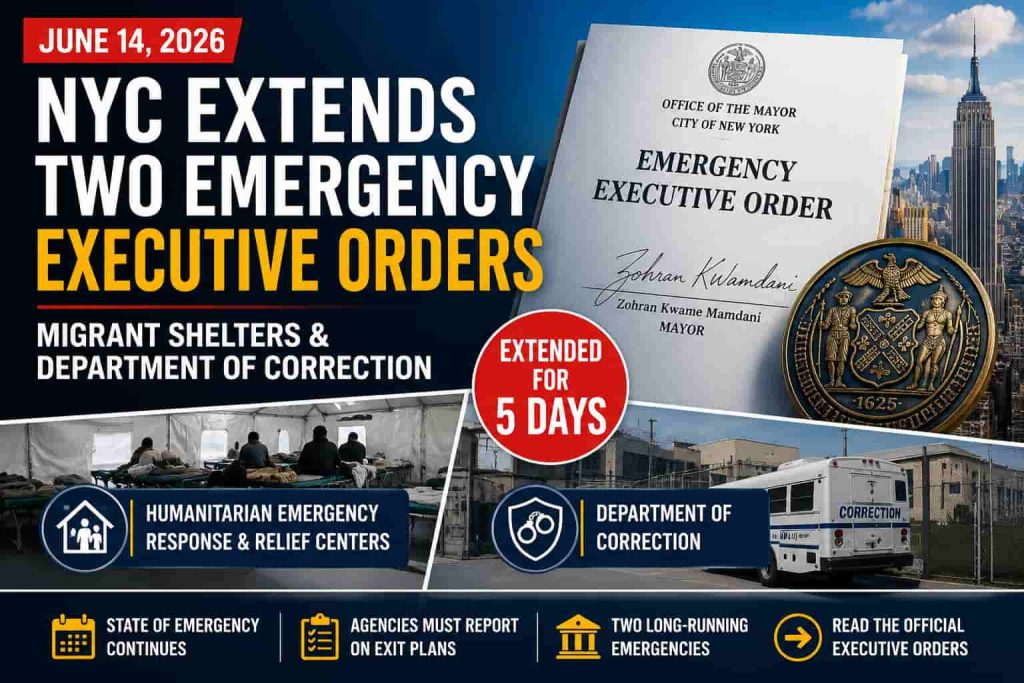
New York City Mayor Zohran Kwame Mamdani signed two emergency executive orders on June 14, 2026, extending two separate states of emergency that have shaped city government operations for years: one involving migrant humanitarian relief centers and another involving the Department of Correction.
The orders — Emergency Executive Order No. 2.32 and Emergency Executive Order No. 1.32 — do not create a new emergency program. Instead, they continue existing emergency authority for another five days while city agencies work on plans to phase out the need for legal suspensions and emergency rule modifications.
What Emergency Executive Order No. 2.32 Does
Emergency Executive Order No. 2.32 extends parts of the city’s emergency response connected to Humanitarian Emergency Response and Relief Centers, commonly known as HERRCs.
These facilities were created in response to the large increase in new arrivals and asylum seekers in New York City. The original emergency was first declared on October 7, 2022, under Emergency Executive Order No. 224.
The June 14 order extends Emergency Executive Order No. 2.31, dated June 9, 2026, for another five days.
The order also directs the Department of Social Services and the Department of Homeless Services, in consultation with the city’s Law Department, to regularly update the mayor on the implementation action plan and on efforts to phase out facilities that have relied on emergency suspensions or modifications of city laws and rules.
In plain English, the city is saying: the migrant shelter emergency system is still operating, but agencies must keep working on a plan to reduce or end the need for emergency legal exceptions.
What Emergency Executive Order No. 1.32 Does
Emergency Executive Order No. 1.32 deals with a separate long-running emergency involving the New York City Department of Correction.
That emergency was first declared on September 15, 2021, under Emergency Executive Order No. 241. Since then, the city has repeatedly extended emergency authority allowing DOC to operate without full compliance with certain laws and regulations.
The June 14 order extends Emergency Executive Order No. 1.31, dated June 9, 2026, for another five days.
It also requires DOC, in consultation with the Law Department, to regularly update the mayor on which emergency suspensions can be allowed to lapse as part of the city’s plan to return to compliance with applicable laws and regulations.
In simple terms, the administration is continuing temporary emergency authority for the jail system, but it is also requiring progress reports on how DOC can move back toward normal legal compliance.
Why These Orders Matter
The important issue is not only that the orders were extended for five days. The larger issue is that both emergencies are old.
The correction system emergency dates back to 2021. The migrant shelter emergency dates back to 2022. Both were originally presented as emergency responses, but both have continued through repeated executive orders.
The June 14 orders acknowledge a key problem: earlier emergency orders issued before January 5, 2026 did not require a clear plan for eliminating the need for the legal suspensions and rule modifications.
That language matters. It suggests City Hall is trying to move from indefinite emergency governance toward a more formal exit plan.
The Bigger Political and Legal Question
Emergency powers are designed for extraordinary situations. But when emergency orders are extended again and again over several years, they raise serious questions about transparency, accountability, budgeting, oversight, and normal democratic process.
For migrant shelters, the question is whether New York City can continue relying on emergency exceptions to operate temporary housing facilities — or whether the city must create a more permanent and legally standardized system.
For the Department of Correction, the question is whether the city can continue operating under emergency exceptions while trying to address deep problems in jail management, staffing, safety, and compliance.
In both cases, the June 14 orders show that New York City has not yet returned to normal administrative rules.
What Happens Next
Both emergency orders took effect immediately on June 14, 2026 and remain in effect for five days unless terminated or modified earlier.
That means the city may issue another extension unless the administration determines that some emergency powers are no longer needed.
For residents, taxpayers, advocates, and watchdogs, the key point to watch is whether the promised implementation plans actually reduce emergency suspensions — or whether New York City continues the same cycle of short-term extensions.
Bottom Line
The June 14 emergency executive orders are technical legal documents, but they point to a larger story: New York City is still operating parts of its migrant shelter system and correction system under emergency authority years after the original emergencies were declared.
The administration is now formally required to track how these temporary exceptions can be phased out. The real test will be whether the city actually returns these operations to normal legal oversight — or simply continues renewing emergency powers every few days.
Official Government Sources
Official New York City government documents and pages related to the June 14, 2026 emergency executive orders on migrant humanitarian relief centers and Department of Correction compliance.
-
NYC Mayor’s Office — Emergency Executive Order No. 2.32
June 14, 2026 order extending emergency authority connected to Humanitarian Emergency Response and Relief Centers.
https://www.nyc.gov/mayors-office/news/2026/06/emergency-executive-order-no–2-32 -
NYC Mayor’s Office — Emergency Executive Order No. 1.32
June 14, 2026 order extending emergency authority connected to Department of Correction compliance.
https://www.nyc.gov/mayors-office/news/2026/06/emergency-executive-order-no–1-32 -
NYC Mayor’s Office — Executive Orders Archive
Official archive of New York City mayoral executive orders.
https://www.nyc.gov/office-of-the-mayor/news/executive-orders.page -
NYC Department of Social Services
Official city agency involved in social services and emergency shelter administration.
https://www.nyc.gov/site/dss/index.page -
NYC Department of Homeless Services
Official city agency responsible for homelessness services and shelter operations.
https://www.nyc.gov/site/dhs/index.page -
NYC Department of Correction
Official city agency responsible for New York City correction facilities.
https://www.nyc.gov/site/doc/index.page -
NYC Law Department
Official legal agency of the City of New York, referenced in both emergency orders for consultation.
https://www.nyc.gov/site/law/index.page -
NYC Government Publications Portal
Official New York City government publications database, including executive orders and archived legal documents.
https://a860-gpp.nyc.gov/