
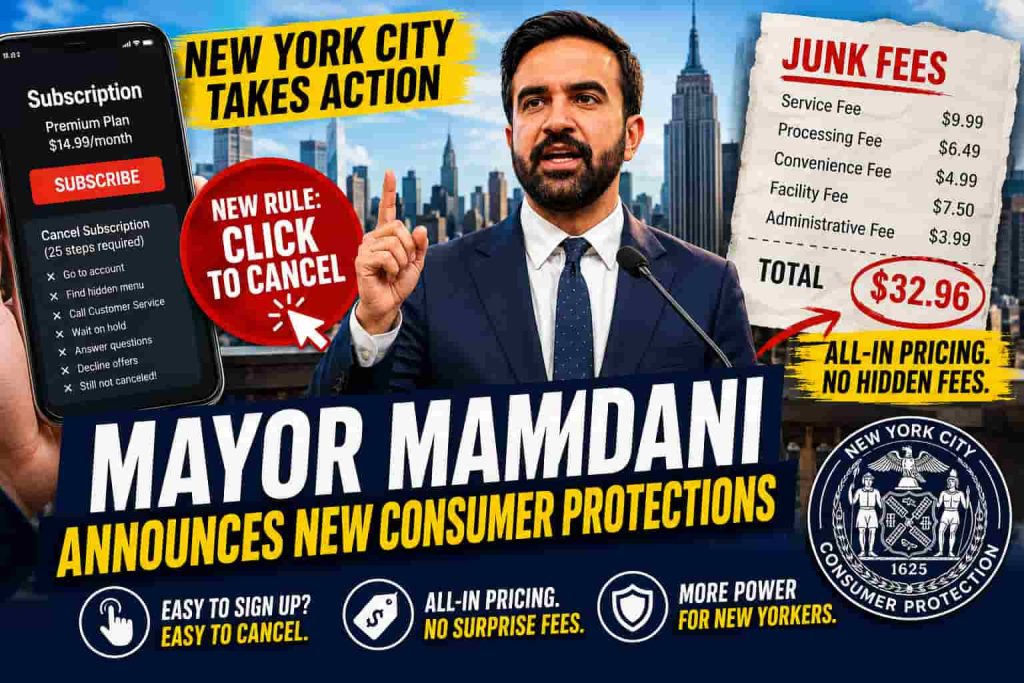
New York City’s new “Click-to-Cancel” rule will require businesses to make subscription cancellations simple, while a separate proposal would require companies to display the full price of goods and services upfront.
NEW YORK — Mayor Zohran Kwame Mamdani and Department of Consumer and Worker Protection Commissioner Samuel A.A. Levine announced a major expansion of New York City’s consumer protection rules on July 10, targeting two increasingly common practices: subscriptions that are easy to start but difficult to cancel, and mandatory fees that appear only near the end of a purchase.
The city’s final Click-to-Cancel rule will take effect on October 1, 2026. It will require businesses offering automatically renewing subscriptions or continuous services to provide consumers with a clear and straightforward way to cancel.
At the same time, the Department of Consumer and Worker Protection, or DCWP, has proposed a broader rule against hidden “junk fees.” That proposal would require businesses to advertise the full mandatory price of a product or service from the beginning of the transaction rather than adding unavoidable charges at checkout.
What the Click-to-Cancel rule changes
The adopted rule applies to automatic renewals and continuous-service subscriptions.
Businesses will be required to disclose subscription terms clearly and provide an accessible cancellation process. The central principle is that a company should not be permitted to make enrollment simple while deliberately placing obstacles in the way of cancellation.
The rule is particularly relevant to services such as:
- gym memberships;
- streaming and software subscriptions;
- online services;
- subscription boxes;
- recurring memberships;
- other services that continue billing automatically.
New York City says this is the first municipal Click-to-Cancel rule in the United States. The official NYC Rules record lists the measure as adopted, with an effective date of October 1, 2026.
For consumers, the most immediate benefit is greater control over recurring charges. People who no longer use a service should be able to stop paying without navigating multiple screens, calling during limited business hours or repeatedly rejecting retention offers.
The city estimates that easier subscription cancellation could save New Yorkers as much as $162.5 million annually, including the value of time currently spent trying to cancel unwanted services. This is a projected maximum rather than a guaranteed amount, but it illustrates the scale of the problem in a city with millions of consumers and recurring digital payments.
What the proposed junk-fee rule would do
The second measure is not yet final.
DCWP has proposed requiring businesses to display the full mandatory price of goods and services upfront. Companies would not be allowed to advertise a lower price and then add unavoidable “service,” “processing,” “convenience” or similar charges later in the transaction.
Businesses would also be prohibited from misrepresenting:
- the purpose of a fee;
- the amount of a fee;
- whether a fee is refundable;
- what service, if any, the charge actually covers.
The city published the proposed rule on July 8, 2026. A public hearing and comment deadline are scheduled for August 7, 2026.
If adopted, the rule could affect a broad range of transactions, including ticket purchases, delivery services, memberships and other consumer services where mandatory charges are frequently disclosed late in the buying process.
The goal is not to prohibit companies from charging legitimate fees. It is to require businesses to include unavoidable charges in the advertised price so customers can make meaningful comparisons before committing to a purchase.
Why all-in pricing matters for New York City
Hidden fees distort competition.
A business that advertises the full price may appear more expensive than a competitor that initially displays only part of the cost. Even when both companies ultimately charge the same amount, the business using a lower headline price can gain an unfair advantage.
All-in pricing would make it easier for consumers to compare offers based on the actual amount they will pay.
That could benefit honest businesses, particularly small and local companies that already disclose their prices clearly. The city argues that stronger disclosure rules will create a more level marketplace by reducing the advantage gained through misleading advertising.
Commissioner Levine said the rules are intended to ensure that “the price you see is the price you pay” and that companies do not gain a competitive advantage by concealing charges or making cancellation unnecessarily difficult.
Enforcement and penalties
Under the proposed junk-fee rule, businesses that violate the requirements could be ordered to provide restitution to affected consumers.
Civil penalties would begin at $525 per violation.
During the press conference, city officials said consumers would be able to report suspected violations through 311 or the DCWP online complaint system. The department may first attempt to mediate disputes and recover money for consumers. In cases involving repeated or systematic conduct, the city could seek court orders and permanent injunctions.
The enforcement structure is important because consumer protection rules depend not only on written requirements but also on the ability of residents to report violations and of the city to act on patterns of misconduct.
DCWP already licenses more than 45,000 businesses across more than 45 industries and enforces New York City’s consumer and worker protection laws.
Who participated in the announcement
The July 10 press conference brought together city officials, a state legislator and prominent consumer protection advocates.
Mayor Zohran Kwame Mamdani
Mayor Mamdani presented the measures as part of his administration’s affordability agenda.
He argued that hidden fees and difficult subscription cancellations place additional pressure on families already facing high housing, food, transportation and childcare costs.
The July announcement followed Executive Orders 9 and 10, which Mamdani signed in January. Those orders directed DCWP to address hidden junk fees and deceptive subscription practices, coordinate enforcement and consider new rules and legislation.
Samuel A.A. Levine
Samuel A.A. Levine, commissioner of the New York City Department of Consumer and Worker Protection, explained how the rules would operate and how the department plans to enforce them.
Before joining the city administration, Levine served as director of the Federal Trade Commission’s Bureau of Consumer Protection. His federal work included cases involving subscription practices, hidden charges and difficult cancellation procedures.
At the press conference, Levine emphasized that pricing transparency protects consumers while also supporting companies that compete honestly.
Julie Su
Deputy Mayor for Economic Justice Julie Su described unwanted subscription charges and hidden fees as small but persistent drains on household budgets.
She also emphasized the value of consumers’ time, noting that hours spent attempting to cancel services represent an economic burden as well as an inconvenience.
Su and Levine were previously named to lead the citywide task force created under the mayor’s executive order on junk fees.
Lina Khan
Former Federal Trade Commission Chair Lina Khan joined the announcement and discussed how subscription traps and hidden fees have developed into significant business models for some large companies.
She referenced federal enforcement actions involving companies accused of hiding costs or making cancellation unnecessarily difficult.
The FTC, for example, sued Adobe and two executives in 2024, alleging that the company obscured early termination fees and created barriers for customers attempting to cancel software subscriptions. The allegations remain part of a legal case and should not be described as a final finding of liability.
Khan said the city’s measures could protect both families and honest businesses from practices that undermine trust in the marketplace.
State Senator Kristen Gonzalez
State Senator Kristen Gonzalez also participated in the announcement.
She said residents across the five boroughs increasingly feel that they are paying more while receiving less, and argued that junk fees and unwanted subscriptions worsen the city’s affordability problem.
Gonzalez praised the administration for using municipal consumer protection authority to return more control to residents.
Council Member Harvey Epstein
City Council Member Harvey Epstein, chair of the Council’s Committee on Consumer and Worker Protection, supported the measures and said straightforward pricing and simple cancellation procedures are necessary to maintain trust between businesses and customers.
His committee has oversight responsibilities related to DCWP and consumer protection legislation.
A longer consumer-protection effort
The July announcement is part of a broader campaign that began early in the Mamdani administration.
On January 5, the mayor signed two executive orders directing the city to increase enforcement against junk fees and subscription traps. That announcement included DCWP Commissioner Levine, New York Attorney General Letitia James and Council Member Julie Menin.
The executive orders created a citywide junk-fee task force, directed DCWP to monitor and investigate questionable practices and called for coordination with the New York State Attorney General and other government agencies.
New York City has already adopted a separate rule addressing hidden hotel fees, which took effect in February 2026.
The broader proposed junk-fee rule would extend the city’s approach beyond the hotel industry to additional sectors of the consumer economy.
What the rules could mean for businesses
Businesses offering recurring subscriptions should begin reviewing their enrollment and cancellation systems before October 1.
Companies may need to examine whether:
- subscription terms are displayed clearly;
- automatic renewal is adequately disclosed;
- cancellation is available through a simple process;
- customers are forced to use a more difficult cancellation method than the method used to enroll;
- unnecessary steps or misleading prompts interfere with cancellation.
Businesses that charge mandatory fees should also follow the proposed junk-fee rulemaking process closely.
Because that rule is still under public review, its final language could change. Business owners, trade groups and residents may submit comments or participate in the August 7 hearing.
Some business organizations have expressed support for easier cancellation while requesting clearer exemptions and more flexibility for regulated industries and business-to-business contracts. Those concerns form part of the formal public rulemaking record and may influence the final version.
What residents should know
The Click-to-Cancel rule is final but does not take effect until October 1, 2026.
The broader junk-fee rule remains a proposal and has not yet become law.
Consumers should continue to review recurring charges on bank and credit card statements, save subscription confirmations and cancellation records, and report suspected deceptive practices to DCWP.
The long-term success of the initiative will depend on several factors:
- whether businesses change their systems before the effective date;
- whether the final junk-fee rule is adopted;
- whether residents report violations;
- whether DCWP can secure refunds and meaningful penalties;
- whether the rules produce clearer competition based on actual prices.
The measures will not eliminate New York City’s high cost of living. But they are designed to address a specific and widespread problem: residents being charged more than they expected or continuing to pay for services they no longer want.
For a city seeking practical ways to improve affordability, pricing transparency and simpler cancellation procedures could allow New Yorkers to keep more of their money while strengthening trust in the local marketplace.
Official Sources
- Mayor’s Office – Mayor Mamdani Announces Landmark “Click-to-Cancel” Consumer Protection Rule and Proposed Junk Fee Rule
- NYC Department of Consumer and Worker Protection (DCWP) – First-in-the-Nation Municipal “Click-to-Cancel” Rule
- NYC Rules – Final Click-to-Cancel Rule
- DCWP Public Hearings – Proposed Rule Prohibiting Hidden “Junk Fees”
- Mayor Mamdani Signs Executive Orders to Crack Down on Junk Fees and Subscription Traps (January 5, 2026)
- Full Press Conference – Mayor Mamdani Holds a Consumer Protection Announcement (July 10, 2026)
- Federal Trade Commission – FTC Action Against Adobe Over Subscription Cancellation Practices
- Federal Trade Commission – FTC v. Amazon (Prime Subscription Cancellation Case)
Editor’s Note: New York City’s Click-to-Cancel rule has been adopted and is scheduled to take effect on October 1, 2026. The broader Junk Fees rule requiring all-in pricing remains a proposed regulation and is currently undergoing the City’s public rulemaking process.